
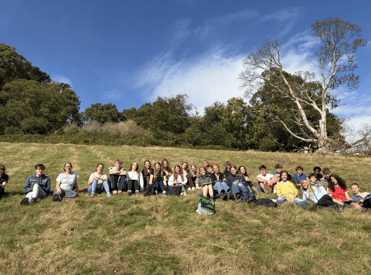
Year 13 Biology students from Kingsbridge Community College sixth form, have put their ecological knowledge into practice during an intensive three-day residential fieldwork trip to Nettlecombe Court.
Based at the Grade I listed estate in Somerset, the students spent three days carrying out practical investigations across a range of habitats, applying the ecological concepts they have studied in the classroom to real-world environments.
The fieldwork focused on sampling both biotic and abiotic components of different ecosystems.
In freshwater habitats, students investigated contrasting microhabitats including riffles and ponds, examining how factors such as flow rate and water movement influence macroinvertebrate communities.
They also had the opportunity to observe and investigate invertebrate behaviour in the field.
The students then turned their attention to terrestrial habitats, mastering the use of point quadrats to accurately measure the percentage cover of grassland vegetation.
They also carried out a unique investigation into the distribution of lichen on gravestones in the historic churchyard, using their findings to explore succession and the effects of microclimate and weathering.
One of the highlights of the trip was a small mammal ecology investigation.
Students set humane Longworth traps overnight in boundary vegetation and successfully caught a shrew.
This provided a valuable opportunity for them to study mammal adaptations and learn more about ethical capture techniques before safely releasing the animal.

The learning continued after the fieldwork each day, with students returning to the classroom to collate their data and carry out statistical analyses.
Tina Graham, Principal at Kingsbridge Community College, said:
“This was a fantastic opportunity for our Year 13 Biology students to take their learning beyond the classroom and experience ecological fieldwork first hand.
The range of investigations they carried out required them to apply their knowledge, collect and analyse real data and work collaboratively as scientists.
“Experiences like this not only strengthen their academic learning but also help our students develop the confidence, independence and practical skills that will serve them well in their next steps.”
Comments
We've recently changed our login process. If you have an account for commenting, you will need to re-register on the login window.
This article has no comments yet. Be the first to leave a comment.