
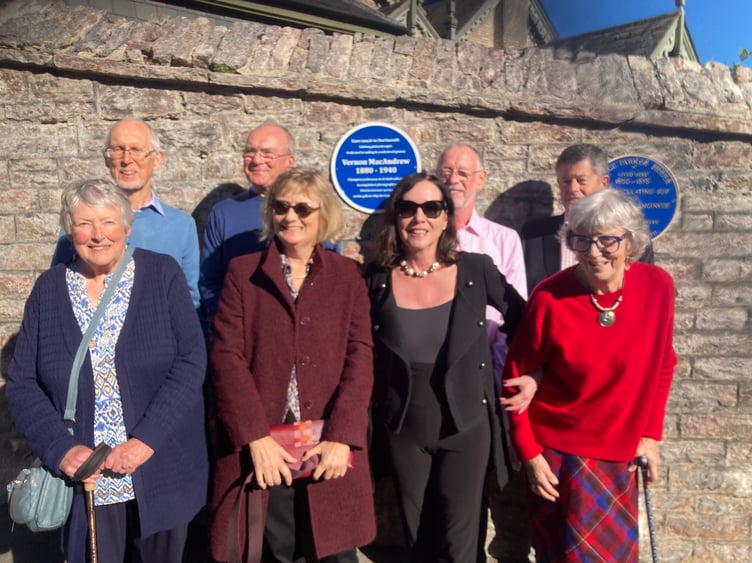
The life of Vernon MacAndrew was celebrated on Monday as a blue plaque was unveiled on his former home Ravensbury (now called Paradise Point) at Warfleet in Dartmouth.
Vernon was one of Britain’s leading racing yachtsmen, a scientific shell collector and accomplished photographer and his achievements were of national importance and he lived in the house for 20 years.
His great nephew Richard MacAndrew unveiled the plaque in front of several members of his family, Dartmouth’s Mayor Cllr Graham Webb, the Vice-Chair of Dartmouth Museum Jonathan Turner and the current owners of the house Chris and Julie Jelf.
Jonathan Turner said it was an important day for the museum which has been the archive holder of the photographs which were donated by Alec and Sue Smith.
“We've been given grants by the Association of Independent Museums and the National Archive to enable us to conserve preserve and promote and demonstrate and show that so we're proud to be part of Dartmouth organizations that are commemorating his achievements and his life,” Jonathan said.
Vernon was born in Merton in 1880 and was the third of five children.
The family owned a large shipping business transporting citrus fruit from Spain and the Balearic Islands to Britain.
The family moved to Surrey and he was educated at Sherborne School in Dorset.
After leaving school he joined the family business and based himself in Valencia.
Vernon married a German called Marie Kastner who took the English name of Haden.
The company was sold in 1917 which made the family financially independent and opened the way for Vernon to pursue his main interests of sailing, photography and natural history.
After WWI Vernon and his wife set up a new life at Bighouse in Scotland where they became the local laird and lady.
They reunited the estate which stretched over 37,000 acres in land from the North Sea.
It was in 1921/22 that Vernon bought Ravensbury in an idyllic position overlooking the Dart and Dartmouth itself.
They opened the grounds for fetes and charitable activities and during WWII part of the house was made available to the Sea Rangers.
Vernon died tragically in 1940 aged just 59 after offering the use of his yacht Campeador for naval service but she was struck by a German mine.
Marie continued to live at the house and donated it to the YMCA which was very much a continuation of the philanthropy.
Vernon’s great nephew Richard Mac Andrew who attended the unveiling said it had been a “moving occasion” for them all and the family were “very proud”.
“We knew about his sailing and we knew a little about his shell collecting. I actually have a little chest of his shells and I knew he lived here,” he said.
“We didn't know about photography at all I didn't actually know about his youth development and so on.”
“Jonathan has done the most amazing job of finding out so much in such a short space of time and I'm sure that there will be more to come out and over the years, but it is fascinating, absolutely fascinating.”
Comments
We've recently changed our login process. If you have an account for commenting, you will need to re-register on the login window.
This article has no comments yet. Be the first to leave a comment.