
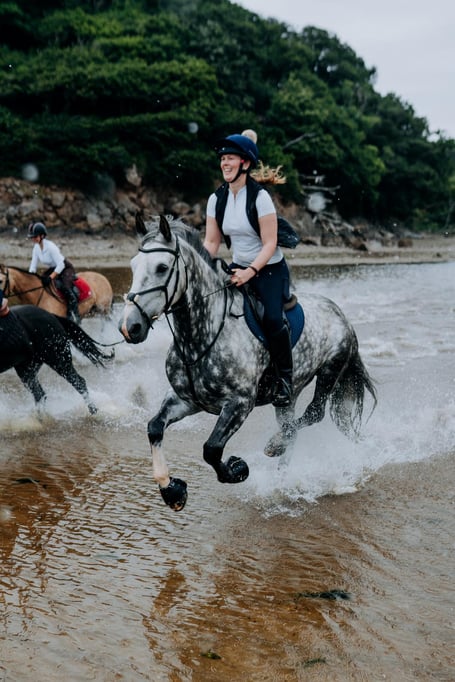
Barney is a beautiful big grey Irish Draft horse. The owner called us at South Moor Equine Vets to see him in November last year because he had gone lame on his right front leg a couple of days previously. Common problems that we see are…common, so I went to see Barney, expecting to find a sore foot as this is the most likely cause of lameness in a front leg in horses.
Unexpectedly, there was nothing to find when I examined him other than swelling of the fetlock joint. In horses, the fetlock joint is a really important, high motion joint that kind of looks like their ankle (it’s actually the equivalent to your knuckle – a horse is basically standing upright on their middle finger/toe). I found no pain associated with Barney’s foot at all, but he was sore when I picked up the leg and flexed the fetlock joint.
There were a few possibilities of what could be wrong with Barney here, the most likely being that he’d traumatised the joint somehow while playing in his field. But, Barney’s temperature was also slightly increased above normal and I wasn’t entirely convinced by the trauma theory. One thing it is important not to miss is infection in the joint (joint sepsis): this is something we see fairly regularly in equine vet work, but is usually associated with a wound/laceration to suggest to us that something might have pierced through the skin and into the joint. I decided to clip all the hair off Barney’s fetlock to check there wasn’t a tiny thorn blood-spot or similar to find, which would tell me it was possible something had gone through into the joint. I found nothing.
A test I can do is to put a needle into the joint to try and aspirate joint fluid, which we can then test to see if there is infection. But, this procedure is not without risk and without having any evidence to suggest Barney had a joint infection, I decided to treat him with pain killers and antibiotics, then re-examine him first thing the next morning.



The following morning, despite the medication, Barney’s fetlock joint was still swollen, although his lameness had improved. Being careful to be sterile, so as not to take bacteria into the joint myself, I placed a needle into the joint and aspirated some joint fluid. The joint fluid was a murky yellow colour…not good. I took the sample back to the laboratory at the practice and the excellent nurse team tested it to check for infection – this was shortly confirmed.
Although we had no idea how on earth Barney’s joint had become infected, it was clear that this was the problem. No amount of antibiotics will fix this: Barney needed surgery. This surgery is not straight forward – you need a full equine theatre and the horse needs a general anaesthetic with keyhole cameras to clean the joint out and check for anything that shouldn’t be in there such as a thorn. Fortunately for Barney, his owner wanted what was best for him and quickly found a way to get out of work and transport him to hospital for his operation.
Barney recovered well from his surgery and is now back being ridden on Dartmoor. We hope he keeps himself away from anything sharp or pointy from now on!
Comments
We've recently changed our login process. If you have an account for commenting, you will need to re-register on the login window.
This article has no comments yet. Be the first to leave a comment.