
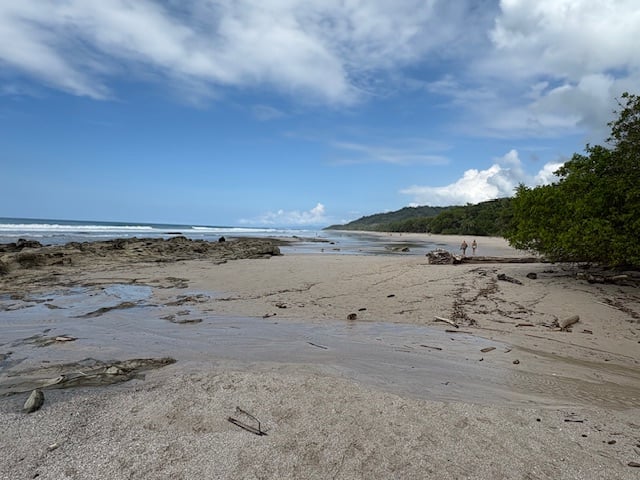
Early last December, Elaine and I were walking in the sunshine on a long sandy beach. A group of sanderlings scurried about at the water’s edge. A common tern flew by. On the rocks were turnstones and a whimbrel. All very familiar. Then, however, there was a slender billed curlew and a willet; that “little egret” had green legs – it was a juvenile little blue heron. That larger heron was brown – a tiger heron. A single file of brown pelicans caught the up-draft from a giant Pacific roller. A group of white-fronted parrots shouted from trees behind us. Black vultures circled above the treetops. Yes, we were back in Costa Rica again.
Before breakfast the next day we were collected by our birding guide, Ernesto, to take us to the Curu Wildlife Refuge, one of the very first Costa Rican wildlife reserves, located on the tip of the Gulf of Nicoya on land purchased by a German family named Schutt.
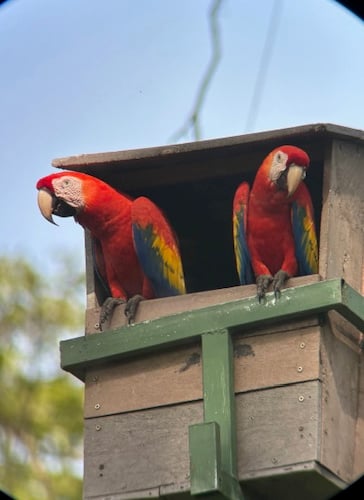
We parked in a clearing just inside the forest edge, where a footpath set off to our right. At the centre of the clearing was a 20 metre black metal pole on top of which was mounted a large nesting box. “An owl box?” Elaine enquired. “No,” was the reply, “it’s for scarlet macaws”. The words hardly out of his mouth, a macaw duly arrived and disappeared inside, shortly followed by its mate. After a while they reappeared, side by side, to survey their surroundings. Not many years ago the scarlet macaw had almost disappeared from Costa Rica, a result of habitat destruction and their capture for the pet trade, now strictly forbidden. As a result of enlightened ecological management and species protection, their reappearance has been clear to us over the twenty-five years that we have been travelling to Costa Rica. Their large size, brilliant colour and raucous calls make them hard to miss. And why, you may ask, are the nest boxes so high and on such tall, thin poles? They are to keep eggs and young safe from the white-faced capuchin monkeys who will predate them given the least opportunity. Nothing seems to be safe from these monkeys unless perched on a very tall, slippery pole.



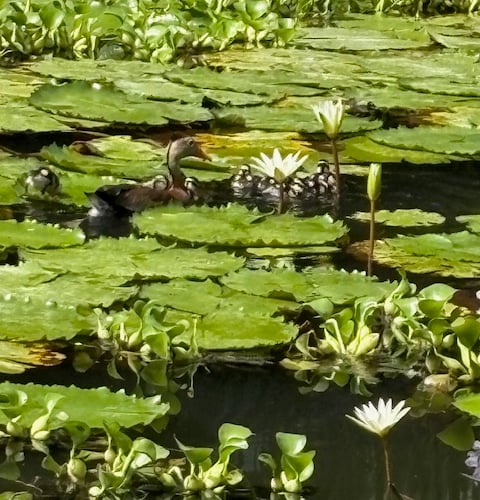
We had not gone far down the track, when our way over a little bridge was blocked by a tribe of about forty coatimundi. We had to wait patiently whilst they filed across and turned off to our left. Further into the forest the path ran beside a large pond, resplendent in water hyacinth through which a black-bellied whistling duck was cutting a path, followed by its ducklings. In a clear area of water a Least grebe was diving repeatedly, overseen by a green heron.
After pauses to admire a lineated woodpecker with its great red crown - there are sixteen types of woodpecker in Costa Rica - and a turquoise-browed motmot, with a long blue tail, our path was blocked again, this time by a howler monkey. It was not blocking the path with its body, they very rarely approach the ground, but it was showing its great displeasure by bombarding us with solid excrement and discharging copious quantities of orange urine down through the leaves. Finally, after its surprisingly prolonged “dirty protest”, Ernesto judged that it must surely be running low on ammunition and we made a rapid dash to freedom. When we reached the sea, there were facilities for us to use, which I am sure the howler monkey would have despised. We feasted on freshly picked pineapples, dripping with sweet juice in their ripeness, which served both as breakfast and a late lunch, before moving on.
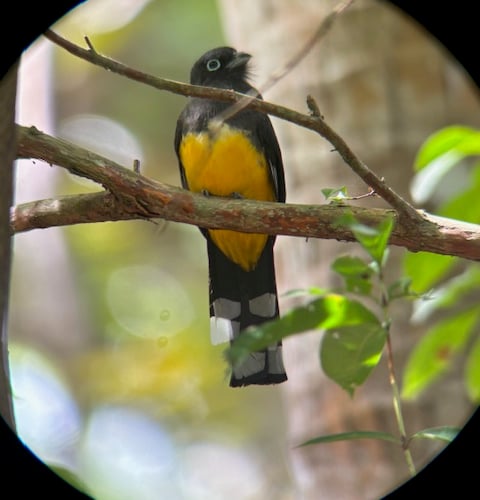
Heading back down the track to recover our vehicle, we paused at a stream to admire a green kingfisher perched over the water, beside which was a reassuringly small crocodile. On a branch nearby sat a black-headed trogan, resplendent in its yellow belly and green back, whilst a family of peccary, wild pig, foraged and crossed slowly in front of us.
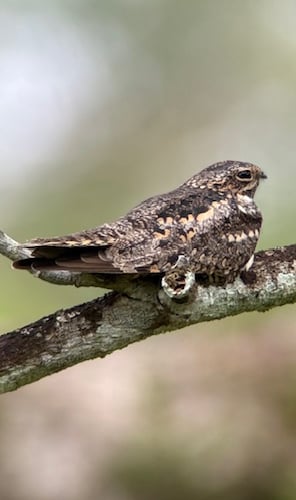
With recently obtained insider knowledge, Ernesto made a slight detour on our drive back, heading down a tiny side road. We stopped by a very unpromising area of small, scrubby trees. He alighted and peered over the barbed wire and then beckoned excitedly. Following his directions with some difficulty, we managed to spot an almost perfectly camouflaged brown bird pressed closely on to the top of a small bare branch. Very similar in appearance to our nightjar, it was a nighthawk, which hides itself during the day, not on the ground but up on a carefully chosen branch. What local knowledge and skill that took to spot.
Comments
This article has no comments yet. Be the first to leave a comment.