

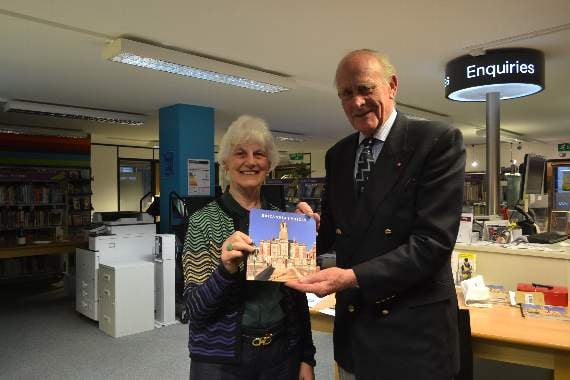
Vice Admiral and Officer Cadet relived his experiences before, during and after World War II in a talk at Dartmouth library.
A fascinating talk shedding light on what it was like to be a cadet at the Britannia Royal Naval College from 1930-1989 was given on Tuesday, September 19, celebrating the book Britannia’s Voices.This is the result of a major oral history project in which 65 cadets were interviewed, recorded and transcribed by a team of volunteers and the results brought together by author Joslin Fiennes.
‘History is made by the people who lived it’, she told the audience, several of whom were former cadets who rose to high positions in ‘The Service’.
One of them, Vice Admiral Sir Jonathan Tod, a cadet in the 1950s, said: “There was little time for homesickness and emotions in the busy, very controlled lives they led at the college.




“The one thing we were not taught was about the sailors we were to command”. These views were typical of those recorded. He described the experience as: “a cross between This is Your Life and Desert island Discs without the music”.
Joslin explained how many things have changed in recent years, particularly the sense of service, and the global role of the Navy. The numbers of those training had been much reduced and changed from 13 year olds there for four years in the 1930s to graduates at BRNC for just a year by the 1990s.
The intake in the early years of the study was mainly from the middle class and public schools, she said. Corporal punishment was normal, even subverted by cadets into a badge of honour, and verbal abuse a matter or course.
They were given ballroom dancing lessons – with no women there. The shared values went back to Nelson’s time. It was seen as a brutal but character forming process teaching men to become leaders. Dartmouth was, nevertheless, seen as too soft by some. The real test was war.
Those interviewed who were at BRNC in the 1930s and 40s had strong memories of the impending war, with barriers built and windows blacked out. When a bomb hit the College in 1942 they were moved out for a time.
The cadets expected to go to war and wanted to. They had a strong sense of patriotism. A third of the BRNC intake perished in the war. Some of the interviewees were active during the Falklands War.
Women did not train there until 1976, and several were interviewed. They were not allowed on vessels and were given lessons in make up and contraception, and encouraged to look feminine – with a prize given for this on the parade ground.
Foreign students also started to be admitted during the period covered by the study and some were interviewed.
A travelling audio-visual interactive exhibition of selections from the interviews will go on tour shortly. The full transcripts will be made available on the website.
The talk was supported by the Britannia Association and Britannia Museum, Devon Libraries and Dartmouth Community Bookshop which sells the book, Britannia’s Voices, copies of which were signed by Joslin at the event. The proceeds go towards the exhibition.
Comments
This article has no comments yet. Be the first to leave a comment.