
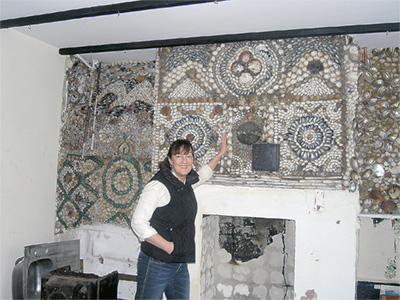
Louise Cotton's new home has left her just a little bit ... well ... shellshocked.
The Lake Street house that she had just bought comes with its own very special décor – tens of thousands of seashells.
The whole front of the Dartmouth 'shell house' is covered in sea shells laid out in unique patterns.
And inside, the walls of the rooms have been decorated just the same – with yet more shells.




Some 30 years ago the house was such a Dartmouth landmark that it had its own postcards on sale in the town.
The house would be opened up to members of the public to have a look at the sea shell art work.
There is even a website fan club for shell decorated homes – including the Lake Street house – with a following of US fans.
The Plimmer family were behind the huge seashell masterpiece which began back in the late 1960s.
Joyce Plimmer, the driving force behind the work, still lives in Dartmouth at the Beacon Court nursing home.
The house on three floors went up for sale last year and was bought by former Radio Devon and Radio 5 Live news editor Louise Cotton just before Christmas.
Louise, who works on a freelance basis for the BBC, is renovating the home and plans to preserve as much of the seashell collages as possible.
Some have had to go because they had become unstable and one even fell of the wall in a stairwell – hitting her on the head.
'It really hurt,' she said. 'A lot of Dartmouth people have asked if I am going to get rid of the shells. Some have had to go but I am trying to preserve as many as possible.
'I quite like the eccentricity of it and I think it is quite amazing that somebody had the imagination and skill to do it in the first place.
'When I bought it I found myself doing research on shell houses.
'The shell house in Lake Street even has fans in the USA. There is a website based in the USA with Americans saying things like wow, just look at this place in Dartmouth.'
Louise said she hopes to move in to the home in a few months time and while she reckons she will not be able to live with all the shell art work – which are in many of rooms and the landings and stair wells – she aims to preserve them even if it means covering them up.
Louise, who grew up in Dartmouth and lives in Undercliffe at the moment, said she had visited the shell house when she was a 17 or 18-year-old teenager.
'I remember it was absolutely covered in shells,' she said.
She said that Mrs Plimmer and her late husband had created the shell work and added: 'My understanding is that Mrs Plimmer was responsible for the artistry covering the outside of the house in sea shells in various patterns.
'The living room is covered with shells on three walls. I am told by Mrs Plimmer's son Jason that the ceiling under the plasterboard in the front room is also all shells but I am not taking that down.'
She added: 'I am told that in its hey day a lot more of the house was covered in sea shells and Mr and Mrs Plimmer used to show people around.
'The shell house even had its own postcards.'
Comments
This article has no comments yet. Be the first to leave a comment.