

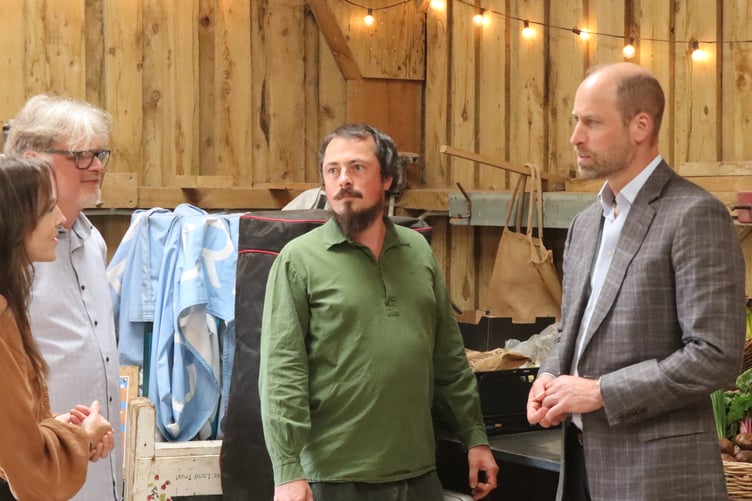
The Prince of Wales met with Rachael Phillips, Managing Director of the Apricot Centre near Dartington, to hear about the value of regenerative farming and their approach to wellbeing and farming education.
His Royal Highness possesses a strong interest in how organisations transition to net zero and, since becoming Duke of Cornwall, has set the Duchy of Cornwall the ambitious target of becoming net zero across the estate by the end of 2032. Set on 120 acres, the Apricot Centre uses organic and regenerative farming methods, including agroforestry, permaculture, rotational grazing, and crop rotation.
Alongside producing food, the Centre supports farmers and land-based businesses and offers nature-based wellbeing therapies and training courses. The Centre also delivers hands-on educational visits for primary and secondary school pupils, giving children the opportunity to explore where their food comes from while developing a greater understanding of food sustainability, biodiversity, and emotional wellbeing.
During his visit, The Prince met with staff, students and children at the farm to hear about how the Apricot Centre has evolved into a financially viable and environmentally pioneering enterprise, achieving an annual turnover of £1.3 million while also becoming carbon neutral and increasing biodiversity across the site by 400 per cent.
The Prince visited the Centre’s on-site wellbeing garden, which originally featured at the RHS Chelsea Flower Show 2025 as an award-winning garden for Bowel Research UK.
He spoke to staff about the organisation’s work supporting mental health and wellbeing before being handed gifts by some of the children in attendance.
Founded in 2015 by husband-and-wife team Marina and Mark O’Connell, the Apricot Centre was transformed from a disused dairy farm into a thriving, biodiverse landscape rich in wildlife. Drawing on Mark’s background in child psychology and Marina’s in horticulture, the couple also developed the Centre’s wellbeing service, founded on the belief that connection to nature, the land, and creativity can transform lives.
Today, the Centre supports the mental, emotional, and social wellbeing of children, young people, families, and farming communities through specialist therapies, therapeutic mentoring, and nature-based farm activities. Its programmes are delivered in welcoming, non-clinical outdoor settings, offering hands-on engagement with the land, food production, and creative activities.
.png?trim=0,0,0,0&width=752&height=501&crop=752:501)
.png?trim=0,0,0,0&width=752&height=501&crop=752:501)
.png?trim=0,0,0,0&width=752&height=501&crop=752:501)
.png?trim=0,0,0,0&width=752&height=501&crop=752:501)
.png?trim=0,0,0,0&width=752&height=501&crop=752:501)
.png?trim=0,0,0,0&width=752&height=501&crop=752:501)
.png?trim=0,0,0,0&width=752&height=501&crop=752:501)
.png?trim=0,0,0,0&width=752&height=501&crop=752:501)
Comments
This article has no comments yet. Be the first to leave a comment.