

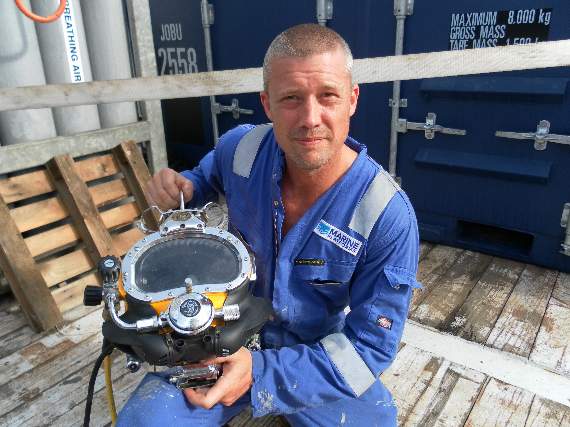
Phil Durdey was working as deep water diver for an oil services company when his nightmare began.
The day they were due to leave after 90 days working on a pipelaying barge in Nigeria, Phil was woken by a friend who heard gunfire.
‘The shooting woke my friend up, who woke me,’ said Phil. The barge they were on had just been boarded by militants from Mend, the Movement of the Emancipation of the Niger Delta.
Unbeknown to Phil, the security detail surrounding their barge had been radioed to warn them of the incoming armed militants – but the message was not passed on.

The gunmen made their way down to the galley and made the galley workers tell them ‘where the white men were’.
When they started banging on the door of the cabin Phil shared with his friend, he knew they would start shooting through the door, so caught between a rock and a hard place, they opened the door and Phil and nine others were bundled into boats by gunmen.
‘One of our guys was shot in the leg,’ remembered Phil, but he didn’t see him again as the militants split the nine men into two groups, one of four and one of five.
He and three others were taken down a ‘maze of rivers’ to the camp. Phil and his friend were trying to gauge how far away from the barge they had been taken.
When they were finally unloaded into what Phil described as a ‘purpose-built’ camp for holding hostages, the two believed they were about 20 miles from their original location.
‘It was a jungle clearing,’ explained Phil. ‘There were huts for the hostages. We weren’t tied up but there were around 30 to 40 heavily-armed men in the camp at any one time and they had an armoury.’
Phil, who now lives in Kingsbridge, explained daily life as a hostage, saying there were some guards who were ‘okay’ and others who were ‘much more sadistic’.
The whole time he was therein 2006 he was subjected to beatings, bullying, not enough food, discomfort, death threats and mock executions.
‘They’d line us up and aim a gun at us, then one of them would fire a gun in another direction and we’d flinch at the noise, then open our eyes and see them all laughing hysterically. They thought it was hilarious.’
Phil said he was always in fear for his life the whole time he was held, but there were ‘varying levels of fear’, depending on the excitement of the guards.
‘These guys were either uneducated or poorly educated,’ he explained. ‘They were usually drunk or on drugs and they were always waving their guns around, cocking them.’
A lot of the time they spent ducking and moving out of the way of a moving gun barrel as it swung around towards them, always afraid of being shot accidentally.
‘If you’re going to be kidnapped, Nigeria is quite a good place,’ said Phil, explaining that was were safer because the kidnappers only wanted ransom money, and to get that, the hostages needed to be kept alive.
At one point, it turned more political and his kidnappers released a statement to his parents, demanding the release of Mujahid Dobuko-Asari, a major political figure of the Ijaw ethnic group in the Niger Delta region, or they would murder the hostages.
Eventually, the ransom for their release was paid. Phil is not sure how much or by whom, but he suspects either by the Nigerian government or the oil company he was employed by.
However, he knows it was nowhere near the $500,000,000 the kidnappers were asking for.
At the time of his release, Phil and his fellow hostages had been planning their escape.
‘We each came up with an escape plan and then picked the most likely to work. Just planning was good for our morale.
‘It was getting quite tense at the end. Two Indian hostages, who had been kidnapped before us had two doctors working as middlemen. The doctors had picked up the money from the company and then scarpered with it, so the guards were angry and agitated.
‘They had just changed the guards too, so we were surrounded by men we didn’t recognise and they didn’t know us. They were crueller.’
Despite having no military training, Phil, who ‘was in the Scouts for a bit’, said they were days away from making their bid for freedom when they were finally released, which Phil called ‘just as scary, if not scarier’ than being kidnapped in the first place.
‘We were told we were going to be executed,’ Phil explained. ‘Another gang turned up and we thought they were going to snatch us, so we ran into the jungle, but they caught us and we were put into boats.’
Phil said the moment of relief came when he spotted the other five men taken from their barge, in a boat with ‘official-looking’ men and he hoped for the first time that they might be released. The man who had been shot in the leg had received no medical treatment for his wound but all had survived their ordeal.
Phil called his experience ‘not one I would ever want to go through again’, but that now he was safe and it was over, he was ‘glad’ it had happened.
Although soon afterwards he would tense at loud noises and while he was there he got ‘tired’ of the noise of gunfire, the only ill-effect he has been left with is ‘over-reacting’ to the feeling of something crawling on him, after his time in the jungle with the insects.
The 42-year-old has now written a book, $500,000,000 & Some Goats, about his experiences, where he gives a day-by-day account of his time as a hostage, punctuated with flashbacks of his life, including his time as a crab fisherman in Dartmouth.
Thinking back through his life – as an ‘accident prone’ child, going off the road as an adult and recovering from heroin addiction – was a technique he used during his ordeal to distract his mind from what he was going through.
Unbelievably, Phil returned to Nigeria three weeks after he was released. He said he enjoyed being in the country. ‘It’s like the Wild West.’ He continues to work as a deep water diver, currently in Qatar.
l $500,000,000 & Some Goats is available from Dartmouth Community Bookshop.
Comments
This article has no comments yet. Be the first to leave a comment.