
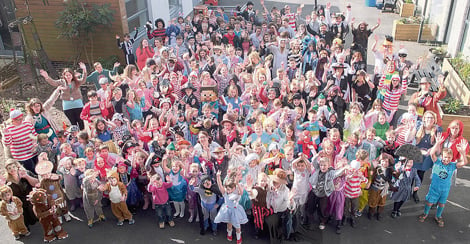
BOOKS and story characters leapt off the page at a special celebration of reading at Dartmouth Academy.
Children from nursery to Year 10 celebrated World Book Day with a wide range of activities.
Both staff and students dressed as their favourite super heroes or characters from a variety children's books including Tin Tin, Asterix, Where's Wally, Gangster Granny and The Gruffalo.
The aim of the day was to explore the key elements that make a children's book special and how to develop a love of reading into adulthood.




Parents got involved, too, by joining secondary students in reading aloud to primary pupils.
Students in years one to nine were challenged with decorating their classroom doors to represent their favourite book before giving a presentation to other students about their choices.
Year 10 students spent the morning producing a play for the rest of the school where they explored themes and recited passages from well-known stories.
The performance in the Newcomen Hall included multi-media projection and a live musical accompaniment from the GCSE music group.
Vice principal Nick Bowles said: 'From the moment of seeing so many parents and older students reading with the primary pupils, I knew we were on the road to a great day.
'The pupils were excited and engaged throughout.
'Throughout the morning there was a real sense of being in it together and the all-through nature was evident in the way the pupils mixed and showcased their work to each other.
'The door displays were fantastic and showed a real range of skill and creativity.'
Principal Nick Hindmarsh said that reading had been a major focus at the academy this year.
'For our students and children to have opportunities in life, they must be able to read well, and express themselves clearly,' he said.
'This starts at home, then in nursery, and continues to be important throughout their time in education.
'At GCSE, a student's vocabulary significantly affects their chances in all their examination subjects, and then their employability when they leave education.
'Some learners arrive in Year 9, for example, with a working vocabulary of more than 20,000 words, whereas a reluctant reader will have a working vocabulary of fewer than 10,000 words.
'This makes a difference to their life chances. Reading matters.'
Comments
This article has no comments yet. Be the first to leave a comment.