
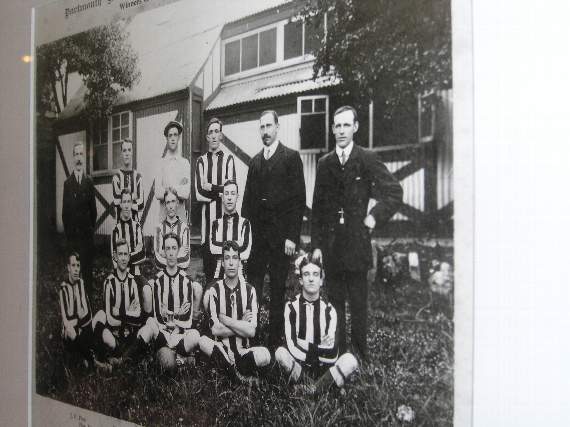
A NEW memorial is due to be installed for Dartmouth’s First World War hero Theodore Veale.
Corporal Veale, then a private, was awarded the Victoria Cross for his bravery in the Battle of the Somme on July 20, 1916.
To commemorate his gallantry, the Department for Communities and Local Government has provided a VC paving stone which will be unveiled at a special ceremony in Dartmouth, exactly 100 years to the day of those historic events.
Cpl Veale’s family, military guests and other local dignitaries will commemorate this centenary at Royal Avenue Gardens at noon on Wednesday.

Cpl Veale’s son-in-law, John Grindell, will be attending the stone-laying ceremony on along with his granddaughter Jennifer.
A memorial plaque to Cpl Veale, of the 8th battalion Devonshire Regiment, is already in place in the Veale/Savill Garden in the town.
On Remembrance Sunday, November 10, 2002, a commemorative service was held in the garden which was attended by Cpl Veale’s daughter Theodora Grindell, now deceased, who unveiled a plaque to her father.
Theodora proudly wore her father’s original VC medal group, loaned by the Devonshire & Dorset Regiment Museum at The Keep, Dorchester, during the ceremony.
Also in attendance were relatives of Sir Eric Savill, who Veale had saved; members of the Devonshire & Dorset Regiment; the Regimental Band, the Royal British Legion; and a guard of honour was provided by cadets from Britannia Royal Naval College, Dartmouth.
Theodore William Henry Veale was born in Clarence Street. The family home was just around the corner in Victoria Road.
His father, Henry, was a builder and his mother, Ada, was a singer. He was well schooled and a talented athlete, and goalkeeper for Dartmouth Assocation Football Club. The club house in Townstal Road has two photographs on its wall of a young Theodore Veale, one taken before the First World War and the other afterwards, with the initials VC after his name.
Theodore was the first volunteer from Dartmouth to join up.
His Devonshire Regiment went to France in 1915. By the time of the Battle of the Somme, Veale was a seasoned and hardy soldier, well aware of the extreme dangers of no man’s land.
An exhibition in Dartmouth Museum depicts an older Veale wearing his VC. The caption reads: ‘He was a military man all his life and was proud of his VC but not ostentatiously so, as you can see from his photo in old age: the VC is almost hidden.’
When he was awarded the VC, the London Gazette, September 9, 1916, reported: ‘For most conspicuous bravery (East of Highwood, France ).
‘Hearing that a wounded officer was lying out in front, Private Veale went out in search, and found him lying amidst growing corn within fifty yards of the enemy. He dragged the officer to a shell hole, returned for water and took it out.
‘Finding he could not single-handed carry in the officer, he returned for assistance, and took out two volunteers. One of the party was killed when carrying the officer, and heavy fire necessitated leaving the officer in a shell hole.
‘At dusk Private Veale went out again with volunteers to bring in the officer. Whilst doing this an enemy patrol was observed approaching. Private Veale at once went back and procured a Lewis gun, and with the fire of the gun he covered the party, and the officer was finally carried to safety. The courage and determination displayed was of the highest order.’
Cpl Veale was invested with his VC by King George V at Buckingham Palace on the February 5, 1917.
In his own words, after seeing a wounded man waving his hand for assistance, he said: ‘I flopped down onto the ground, but got up again and ran on to the spot where the man was waving. To my surprise it was one of our wounded officers, Lieutenant Savill.
‘I laid down and did all I could for him, and I was well fired at whilst I was there. Savill was so close to the Germans I pulled him back about 15 yards, for I found to my surprise that I was only about ten yards from them.
‘I pulled him back, thinking they were going to pull him in. I went back to get some water, and I took it back out to Lieutenant Savill.
‘They fired at me again, and it was surprising how it was that I was not hit. But I meant to save him at all costs; because it was all so open I had to crawl back again, got two more men and a corporal to come with a waterproof sheet, which we put Savill on.
‘We tried to pull Savill back. We got about 80 yards, and then had to rest.
‘The corporal stood up like on his knees and we saw five Germans pop up out of the grass about 100 yards away. We had to go over a bit of a bridge, and they shot the corporal (Cpl Allen) through the head. That made the other two with me nervous, and they wanted to get back. So I said: “Get back, and I’ll manage.”
‘So they went and I pulled the wounded officer into a hole and left him comfortable, and went back. Then I sent a team out to cover any of the Germans that might try to fire at Savill, and tracked out to him myself again with water.’
Later Pte Veale went out again with the chaplain, who was also acting as stretcher bearer, Lt Duff and Sgt Smith.
They reached Savill just before dark and when they were going to get him home they spotted another group of Germans creeping up.
Lt Duff covered the Germans with his revolver while Pte Veale, risking his life again, ran back for his Lewis gun, a total of 150 yards, and then raced back.
At this fifth attempt, with fire of the Lewis gun, Pte Veale covered the party and the officer was finally carried to safety.
Cpl Veale died on November 6, 1980, at his daughter’s home in Hoddesdon, Hertfordshire.
He was cremated at Enfield Crematorium, Middlesex, and his ashes scattered in the area.
Comments
This article has no comments yet. Be the first to leave a comment.