
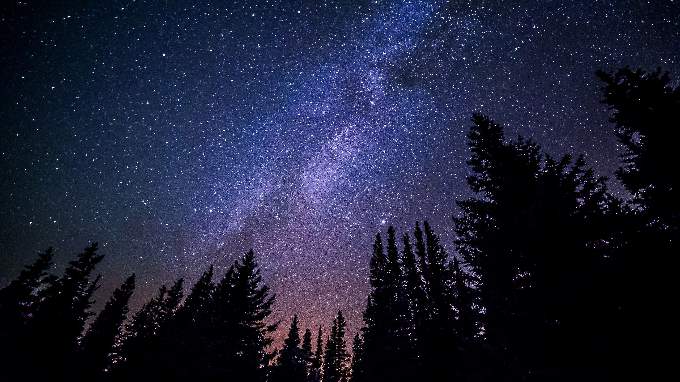
Devon Dark Skies Week includes an evening on-line talk with expert speakers. On Thursday October 28 Bob Mizon MBE from the UK Commission for Dark Skies and Ivan Buxton from Devon Campaign to Protect Rural England will be explaining the importance of the night sky and what we can do as individuals and communities to reduce the negative effects of artificial lighting. The talk starts at 7pm.
Devon Dark Skies Week is led by organisations involved in the Devon Local Nature Partnership (LNP), encouraging everyone to become more aware of darkness and its importance.
Professor Michael Winter, Chair of Devon LNP said:

“In line with Government ambitions, the Local Nature Partnership is working to help achieve a Nature Recovery Network across Devon. It is vital that this network of wildlife habitats is protected from the impacts of lighting. As life begins to return to normal, it is important for us to reduce light pollution from our homes and businesses, so that our wildlife can thrive, and we can continue to enjoy the benefits our dark skies bring.”
Dark skies are important to our wildlife, especially nocturnal species. Light pollution can interrupt natural rhythms, including migration, breeding, and feeding. Predators use light to hunt, and prey species use darkness to protect themselves. Birds that migrate or hunt by night may use the moonlight and starlight to navigate.
Street lighting, domestic lighting, and lights from businesses, farms and community buildings contribute to overall light levels. Making better choices about when and how we use light can make a big difference. Whilst some lighting at night is important for our safety, unnecessary artificial light spilling into the night sky is a waste of money and energy; it increases our carbon emissions which in turn has a negative impact on our environment.
Many organisations and communities across Devon are already taking action to reduce light pollution. Cllr Andrea Davis, Devon County Council’s Cabinet member for Climate Change, Environment and Transport and Vice Chair of Exmoor National Park says:
‘‘Devon County Council and Exmoor National Park are delighted to support Devon Dark Skies Week. Devon County Council is responsible for more than 75,000 streetlights across the county and is taking forward important measures to reduce impacts. These include replacing lanterns with low energy LEDs, introducing part-time lighting and dimming in urban areas and working with communities in Buckfastleigh and Chudleigh to reduce the impacts of street lighting on rare Greater Horseshoe Bats.”
Visit Devon LNP’s website – www.devonlnp.org.uk – for information about dark skies, activities, and simple things that we can all do to reduce light pollution.
Keep up-to-date and join the conversation on social media using #devondarkskies.
For more information contact Katrina Crenol: [email protected] 01392 385 268.
Devon Local Nature Partnership (LNP)
Devon LNP was established in 2012. It is a voluntary strategic collaboration of a huge range of organisations, groups and individuals committed to working together to restore Devon’s natural environment for people, wildlife and business.
The three goals are to deliver a Nature Recovery Network – Protect and restore a network of wildlife-rich habitats and natural systems across the county in towns, villages, rural areas and at sea, respond to the climate emergency – use natural solutions to capture carbon and increase our resilience to climate change and flooding. Restoring peatlands, wetlands, saltmarsh and soils along with creating new habitats such as woodland will help us to achieve net zero and increase our resilience and connect people and nature – support communities and businesses to value and enhance the natural environment which underpins health, wellbeing and our economy.
Ways to reduce adverse impacts of artificial lighting?
• Avoid using lighting! Artificial light is hugely beneficial in some situations. However, we should always think twice as to whether it is essential.
• Reduce light spill. Design lighting to minimise light spill into areas where it isn’t required for example, through the design of the light fitting, use of walls / fences / dense vegetation to block light, or shutting curtains at night.
• Ensure that lights are only on when required. Use motion sensors, timers for street lighting or just switch off lights that aren’t needed.
• Reduce brightness. Lighting should only be bright enough to fulfil its function. Reduce brightness through choosing blubs with lower lumens. If you are trying to keep an area dark for wildlife such as a dark corridor the light levels entering the habitat should not be greater than the normal night light levels or 0.4 lux vertically and 0.2 lux horizontally.
• Use warm lighting. Where possible use warm LED lighting of 2700K or less to reduce the blue/UV component. Warmer light reduces impacts on wildlife, human health and sky glow.
Comments
This article has no comments yet. Be the first to leave a comment.