

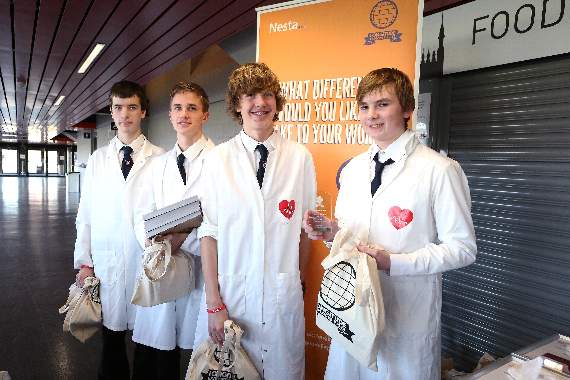
TECH savvy students from Dartmouth have helped to design a groundbreaking app that helps paramedics find the best route to hospitals.
Ross Veale, 15, and Benjamin Lavers were among the Churston Ferrers Grammar School team whose lifesaving project won a cash prize of £5,000 at a London conference. Along with team members Finbar Kneen and Joseph Goodall, the enterprising students were runner-ups in the Longitude Explorer Prize.
Their project Fast Aid is a data and navigation tool to be located in ambulances which will help crews plot the quickest route through traffic and check live data about nearby hospitals, including the number of available beds.
They were also named as the ‘people’s choice’ winners by visiting students to the 2015 Teen Tech conference, which was held at the Queen Elizabeth Olympic Park in East London.

Launched by UK innovation charity Nesta in November 2014, the Longitude Explorer prize is a youth-focused challenge for secondary students which aims to expand their abilities in technological creativity.
Groups of 11 to 16-year-olds across the country took up the challenge of using satellite location data to solve social challenges.
Of the 600 teams who entered, 12 finalists were selected to present their ideas to judges and other secondary school students at the conference.
The judges praised the breadth of ideas and high quality of the entries.
The Churston team said: ‘We’d been hearing lots of stories in the news about the NHS facing problems with funding and we thought that we would be able to create something that would help people and health workers make the most of what’s available.’
Project leader Ross and Benjamin have been friends since they both went to St John the Baptist Primary School in Dartmouth.
The team, who were flown from Exeter to London by Nesta, now hope the device may be taken up by the NHS and used in the field.
Constance Agyeman, development manager at Nesta, said: ‘We would like to congratulate all the winners of the competition along with all the other finalists.
‘The standard of entry was excellent and it was a very hard job for the judges to select just three.
‘It is encouraging to see so many young people energised by the idea of using digital creativity to solve social challenges.’
The students won money for the school and also came away with an iPad mini, Raspberry Pi and Jawbone monitors for each of them.
They were supported by school technician Nigel Harris and head of design and technology Bruce Nisbett, who also won the best teacher award.
Comments
This article has no comments yet. Be the first to leave a comment.