

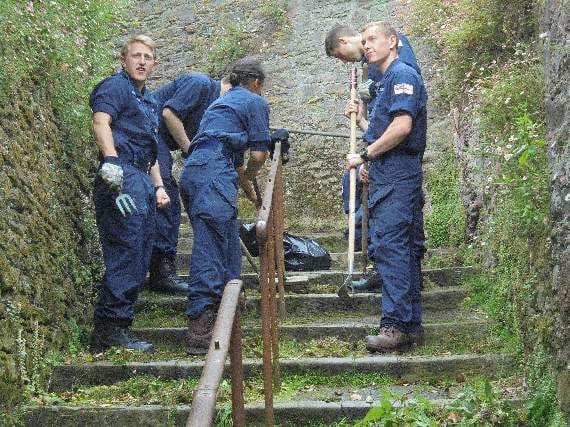
THE Dartmouth and Kingswear Society have raised concerns over the safety of some paths and steps in the town, blaming ‘lack of maintenance’ by local authorities.
The need to improve path and steps safety in Dartmouth was discussed at a recent public forum at the Flavel, organised by the Dartmouth and Kingswear Society.
Kathy Stansfield, Dartmouth and Kingswear Society secretary reports that they said ‘much of the problem is due to lack of maintenance by South Hams District Council and Devon County Council’.
Dartmouth and Kingswear Society chairman, Tony Fyson, showed pictures of the poor state of pavements and roads in Dartmouth taken through the past year. Weeds have taken root and steps have become treacherous ‘hanging gardens’.



Kathy said: ‘The problems on steps are exacerbated by the sloping treads of the old brick pavings. Even on flat surfaces such as the Embankment or Royal Avenue Gardens the surfaces become very slippery after rain.
‘Much of the problem is due to lack of maintenance by South Hams District Council and Devon County Council. Weeds and slime become lethal in wet weather. Soil is building up in the cracks which would not happen if there was regular cleaning.
‘Even handrails have been made unusable due to weeds growing in the walls. Loose pavings and kerbs and potholes in the roads are all hazards.’
‘The physical maintenance of pavement is a statutory DCC responsibility’ said Tony Fyson. ‘But since 1974, SHDC has swept and weeded pavements under an arrangement whereby DCC paid for the work.
‘The system collapsed last year because DCC ran out of money and staff. Dartmouth Town Council applied to the special Town and Parish fund of SHDC to do the work as a one-off arrangement.’
There have been attempts by volunteer groups to remove weeds from pavements, such as Britannia Royal Naval College cadets, Dartmouth Green Partnerships and Community Payback.
Many residents and businesses try to keep the areas outside their homes or shops clean. However this is not a solution everywhere – the job is too big and too important to rely on volunteers. And problems can be exacerbated by removing weeds in a way which which might loosen the pavings.
Kathy continued: ‘Using traditional systemic weed sprays, containing glyphosate, is a problem. Only those trained and qualified can now use such sprays in public places, and there are worries about them being used close to water. Some councils have banned or restricted their use. ‘Alternatives are salt, hot water, vinegar and flamethrowers! Councils need to find suitable alternatives to keeping weeds down. However there is no substitute for regular cleaning.’
Following a letter from the Dartmouth and Kingswear Society in the Chronicle on January 27, asking for information about accidents involving loose or slippery pavings several people responded with accounts of injuries including broken ribs and ankles requiring medical attention.
There are also aesthetic issues, such as the replacement of the old paving blocks with tarmac, as on a repair by a utility company on the lower part of Horn Hill.
The Dartmouth and Kingswear Society is ‘disappointed’ to see the pavement outside the new ‘Sails’ housing development on the corner of Coronation Park has been laid in tarmac, cheap and easy to maintain but very unattractive, and the ‘poorly laid concrete’ on the North Embankment is ‘unacceptable’. Complaints to the relevant organisations have had no result.
Loose pavings and kerbs are particularly dangerous and should be reported to DCC by telephoning 0845 155 1004. It is advisable not to rely on the website but to talk to someone, and that action is usually taken promptly.
The sloping step treads in areas such as Chapel Steps, School Steps and Ridge Hill is a much bigger problem. Tony Fyson suggested that the Dartmouth and Kingswear Society promotes a limited trial area on steps to see if remodelling them with flat treads, by introducing extra steps, works. This would need planning permission.
It was also suggested that a Record Book be made available at the Town Hall for people to report issues so that a record of accidents is kept and priority problem areas can be identified.
Comments
This article has no comments yet. Be the first to leave a comment.