

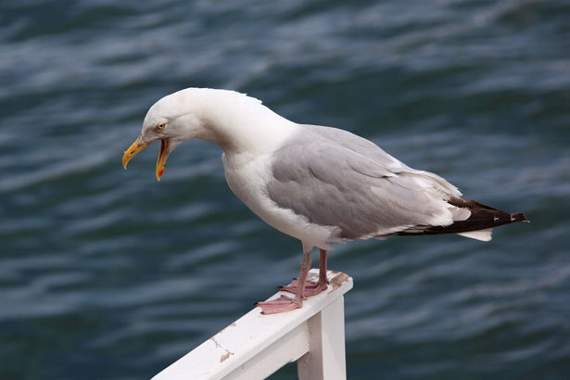
BUSINESS owners are being asked whether they want to continue paying thousands of pounds for a hawk to scare away sea gulls.
Dartmouth Business Improvement District is conducting a survey of its levy payers, asking whether they would like to continue the programme which started last year.
A BID spokesman said: ’Most of you will know that last year we embarked on a program of Sea Gull Control with NBC Bird & Pest, in an attempt to curtail the nuisance caused by Sea Gulls in our town. The programme started last May, has involved regular weekly and sometimes daily visits by NBC and their hawk and this program is shortly to come up for review by the BID, with a decision needing to be taken as to whether we continue for a second year.’
In a newsletter to levy payers, the BID said: ’We recognise that this is a highly contentious issue and the BID Directors would like to know whether you are for or against continuing for a second year? It is almost impossible to find hard evidence as to the success or otherwise of the program over the last year, so: this is your money and the sea gulls are in your town and it’s your opinion that we need to help make the decision.’

The newsletter added: ’A number of people have told us that the hawk was an effective deterrent last year and that there are less seagulls around the town than there used to be. However, we know for certain that gulls have attacked people in the town and we know of one man who had to be taken to hospital and a family who swore never to return to Dartmouth after their daughter had a sandwich snatched from her hands as she was eating. ’
An NBC spokesman said: ’With this type of work the second year is always more successful as the presence of a bird of prey has been established over the last twelve months.
’The gulls when they start to return to their nesting sites, will see that the hawk is still present and more will look for alternative nesting sites knowing that their nesting last year was disrupted.
’Years ago gulls used to nest out of towns and cities on cliffs and it is people feeding them and the sheer amount of accessible food which draws them in.
’Experts who professionally study gull behaviour have noted a rapid decline in coastal gulls and a large increase in our towns and cities. The aim of our work is to encourage the gulls to return to their more natural nesting sites where they will be left in peace to breed as they used to. Some people are anti the work think that gulls will be harmed which is not the case, the birds we use are trained not to actively hunt the sea gulls but just to deter them with their presence.’
To provide a two-hour flight programme once a week from March to September, and once a month visits during the remainder of the year, costs a total of £4,600.
BID members are asked to email ’yes’ or ’no’ to the [email protected], putting ’Sea gull’ in the subject box.
The newsletter added: ’Please do not add anything further – with the potential for over 700 responses we simply do not have the resources to enter into a dialogue with levy payers on this subject.’
Comments
This article has no comments yet. Be the first to leave a comment.