
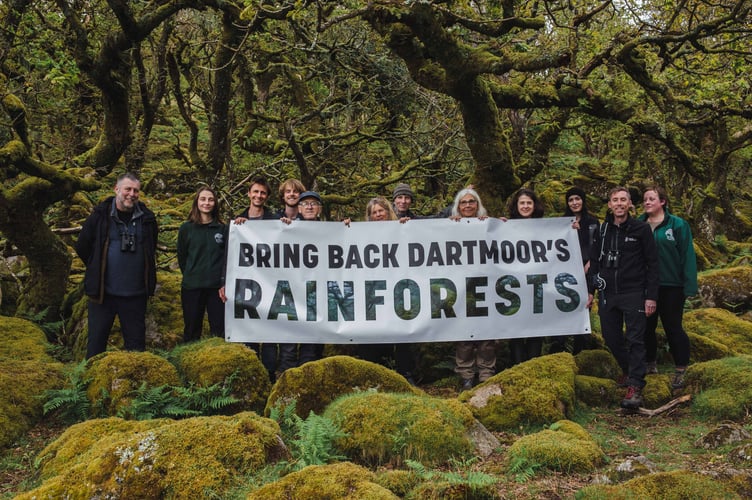
Dartmoor’s ancient rainforests – including the famous Wistman’s Wood – could be extended and reconnected in a major restoration campaign.
The Dartmoor Nature Alliance is calling for the regeneration and expansion of the moorland’s surviving patches of ancient temperate woodland at Black-a-Tor Copse near Okehampton and Piles Copse near Ivybridge.
Work is already under way to extend Wistman’s Wood by planting new saplings, cultivated from the wood’s own acorns and rowan seeds.
Despite Dartmoor’s global importance as part of the UK’s rainforest zone, much of this habitat has disappeared over the centuries. The remaining temperate woodlands are now isolated and struggling to regenerate because of grazing pressure on Dartmoor’s commons.
.jpeg?width=209&height=140&crop=209:145,smart&quality=75)


The Dartmoor Nature Alliance (DNA) wants to see rainforest cover on the moor’s commons doubled, from around 1,882 acres to more than 3,700 acres.
The campaign will push for changes to commons legislation and land management rules that are currently preventing woodland recovery on Dartmoor’s commons.
One of the key issues is grazing pressure. The Dartmoor Commoners Council is the only organisation with existing legal powers under the Dartmoor Act 1985 to manage grazing levels across all the commons. Natural England also has some power on protected sites.
However, the Dartmoor Nature Alliance is calling for fundamental legislative change to ensure, amongst other measures, that new conditions are attached to all grazing rights, to ensure that grazing is legally kept within environmentally sustainable limits. It’s hoping other organisations such as the National Park Authority will support this.
The campaigners argue that restoring rainforest would help tackle Dartmoor’s nature crisis while also storing carbon, reducing flood risk and creating richer habitats for wildlife.
On Wednesday, May 20, supporters gathered at Black-a-Tor Copse, which is owned by the Duchy of Cornwall, to launch the campaign.
Lisa Schneidau, storyteller and DNA core group member, said: “Black-a-Tor Copse shows us what Dartmoor once looked like and what it could look like again.
“These woods are alive with mosses, lichens and wildlife, but they’re trapped as tiny fragments and unable to spread.
“There’s no reason why Dartmoor’s river valleys couldn’t once again support thriving rainforest. What’s needed now is ambition, determination and public support to make it happen.”
Guy Shrubsole, rainforest campaigner and DNA core group member, said: “Black-a-Tor Copse is a rainforest on its last legs - hollowed out by a honey fungus outbreak and nibbled to death by sheep.
“It urgently needs to be given the space to naturally regenerate and spread - an assessment backed by the government’s nature watchdog, Natural England.
“The Duchy and Okehampton commoners must urgently work together to make positive change happen here, following the encouraging progress being made at Wistman’s Wood.
“What is needed is a large ‘exclosure’ fence around the north-east side of Black-a-Tor Copse to protect it from yet more overgrazing, and allow fresh saplings to grow. It’s time to bring back Dartmoor’s rainforests.”
The Dartmoor Nature Alliance is inviting the public to support its campaign by sending messages, artwork, poetry, and photographs inspired by Dartmoor’s rainforests and by its own vision for the moor’s future – which is set out in its 2025 Call to Action https://www.dartmoornature.org.uk/our-vision
Comments
We've recently changed our login process. If you have an account for commenting, you will need to re-register on the login window.
This article has no comments yet. Be the first to leave a comment.